Carbohydrates as the foundation of tree performance
Carbohydrates (CHOs), or non-structural carbohydrates (NSCs), form the foundation of productivity in macadamia trees. Produced through photosynthesis, these compounds – primarily sugars such as sucrose and storage forms like starch – serve as the main energy source for all physiological processes, including growth, maintenance and reproduction. In perennial crops, carbohydrate status reflects the balance between carbon supply and demand, where photosynthetic production must exceed the combined requirements of respiration and growth for reserves to accumulate (Lötze & Brown, 2026; Shi et al., 2024).
In macadamias, this balance is particularly critical because the crop is largely photosynthesis-limited, meaning yield potential is directly constrained by carbohydrate availability.
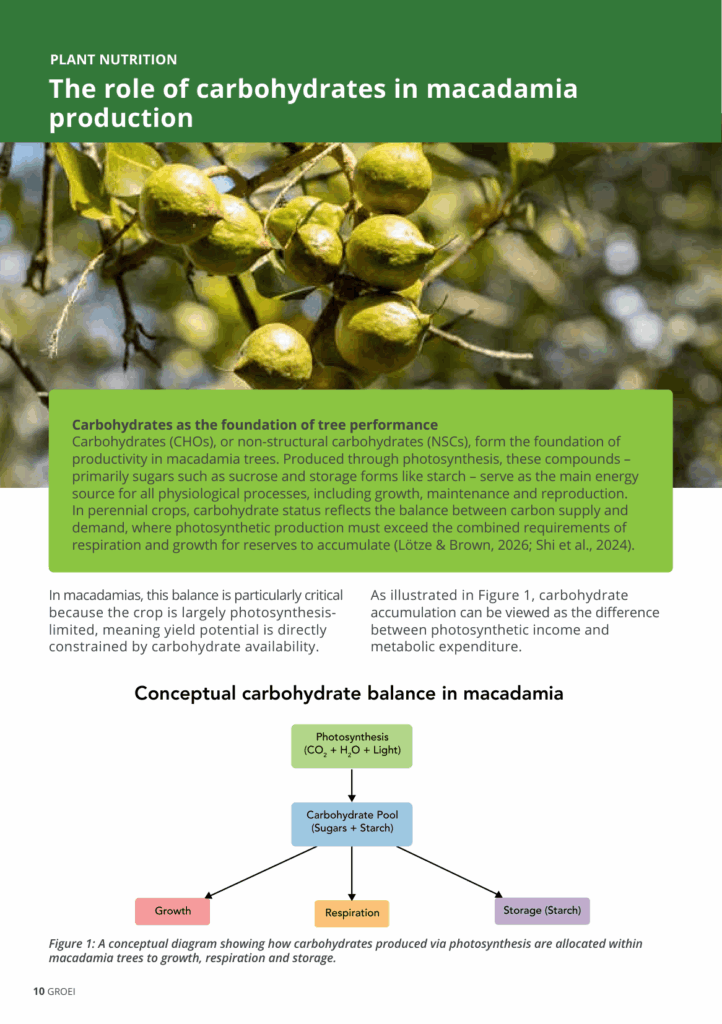
As illustrated in Figure 1, carbohydrate accumulation can be viewed as the difference between photosynthetic income and metabolic expenditure.
Figure 1: A conceptual diagram showing how carbohydrates produced via photosynthesis are allocated within macadamia trees to growth, respiration and storage.
Source-sink dynamics in macadamias
Carbohydrate distribution within the tree is governed by source-sink relationships. Leaves act as the primary source of carbohydrates, while developing organs such as flowers, fruit, shoots and roots act as sinks. In macadamias, reproductive structures represent the strongest sinks, competing aggressively for available energy.
This competition determines yield outcomes. When carbohydrate supply is insufficient, the tree reduces sink demand through flower or fruit drop, a phenomenon widely observed in perennial crops (McFadyen, 2006).
Flowering in macadamias comes at a cost
Flowering represents one of the largest carbohydrate investments in the macadamia production cycle.
This substantial energy demand occurs over a short period, placing significant pressure on both current photosynthesis and stored reserves. Given the inherently low conversion of flowers to harvested nuts, flowering can be viewed as a high-cost, low-efficiency process from a carbohydrate perspective.
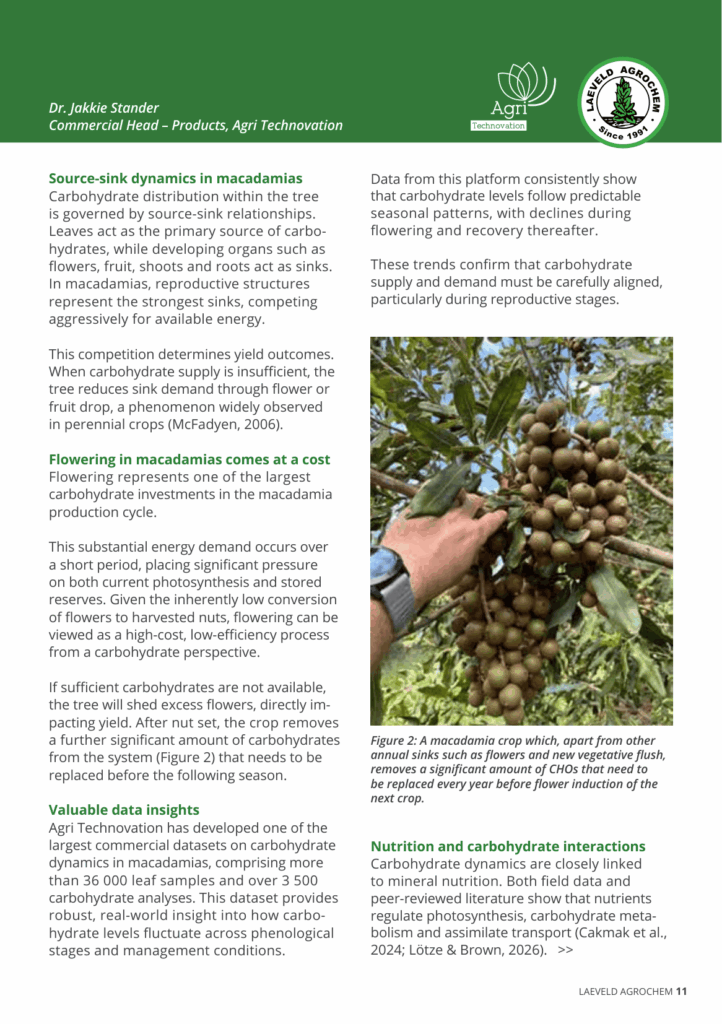
If sufficient carbohydrates are not available, the tree will shed excess flowers, directly impacting yield. After nut set, the crop removes a further significant amount of carbohydrates from the system (Figure 2) that needs to be replaced before the following season.
Valuable data insights
Agri Technovation has developed one of the largest commercial datasets on carbohydrate dynamics in macadamias, comprising more than 36 000 leaf samples and over 3 500 carbohydrate analyses. This dataset provides robust, real-world insight into how carbohydrate levels fluctuate across phenological stages and management conditions.
Data from this platform consistently show that carbohydrate levels follow predictable seasonal patterns, with declines during flowering and recovery thereafter.
These trends confirm that carbohydrate supply and demand must be carefully aligned, particularly during reproductive stages.
Figure 2: A macadamia crop which, apart from other annual sinks such as flowers and new vegetative flush, removes a significant amount of CHOs that need to be replaced every year before flower induction of the next crop.
Nutrition and carbohydrate interactions
Carbohydrate dynamics are closely linked to mineral nutrition. Both field data and peer-reviewed literature show that nutrients regulate photosynthesis, carbohydrate metabolism and assimilate transport (Cakmak et al., 2024; Lötze & Brown, 2026).
A well-established trend is the inverse relationship between nitrogen and carbohydrate levels, where higher nitrogen availability often shifts carbon allocation towards growth rather than storage (Yang et al., 2024). This pattern is consistently observed in commercial macadamia systems.
Rather than focusing on individual nutrients, it is more appropriate to view carbohydrate status as a reflection of overall plant balance. Nutrient interactions influence how carbohydrates are produced, transported and stored, particularly during high-demand periods such as flowering.
From measurement to management
Importantly, Agri Technovation is currently the only company offering a commercial laboratory service for carbohydrate analysis in tree crops, known as ITEST™ CARBOHYDRATES. This platform enables producers to move beyond indirect indicators and directly measure carbohydrate status in leaves and roots, providing actionable insights into tree energy dynamics.
The ability to measure carbohydrates directly has created new opportunities for proactive management. Through ITEST™ CARBOHYDRATES, carbohydrate status can be monitored across the season, allowing for more precise decision-making.
In addition to measurement, targeted interventions can be used to influence carbohydrate dynamics. Products such as TRY ME™ (Reg. no. K9552) and Nuts-to-Grow™ (Reg. no. K9551) have been shown to increase total carbohydrate levels following application. These approaches aim to maintain higher photosynthetic activity and improve the availability of carbohydrates during critical reproductive stages.
This combination of measurement and intervention represents a shift towards data-driven carbohydrate management, where decisions are based on the actual physiological status of the tree, rather than assumptions.
Linking mineral nutrition to flower carbohydrates
Recent research has further strengthened the link between nutrition and carbohydrate dynamics in macadamias. Lötze and Brown (2026) demonstrated that carbohydrate levels in macadamia flowers can be predicted from tissue mineral composition with high accuracy (R² = 0,85 – 0,96).
This confirms that carbohydrate availability in flowers – the most energy-demanding organs – is closely regulated by nutritional status. It also highlights the potential for predictive models and precision nutrition strategies to optimise carbohydrate supply during flowering.
Environmental and soil constraints
Soil and environmental conditions play a critical role in carbohydrate production. Factors such as salinity and sodicity can impair root function, reduce nutrient uptake and limit photosynthesis.
Services such as ITEST™ Soil and MYSOIL™ Classification are therefore fundamental to the interpretation of orchard condition and planning of an integrated fertiliser and crop manipulation strategy.
These constraints reduce carbohydrate availability and disrupt the tree’s energy balance. Maintaining good soil structure, drainage and root health is therefore essential for sustaining carbohydrate production, particularly during high-demand periods.
Leaves, storage and seasonal dynamics
Leaves are the primary source of carbohydrate production, exporting sugars to sink organs throughout the tree. Carbohydrates are stored mainly as starch, which acts as a reserve to buffer fluctuations between supply and demand.
Seasonal changes in starch and sugar levels reflect how effectively the tree is managing its energy balance. Monitoring these patterns provides valuable insight into the tree’s ability to support flowering and fruit development.
Practical implications for producers
Carbohydrates underpin every aspect of macadamia production, particularly during flowering when demand peaks sharply. The integration of large-scale commercial data, direct measurement through ITEST™ CARBOHYDRATES and emerging scientific research shows that carbohydrate status is both measurable and manageable.
By aligning nutrition, soil health and timing with the physiological needs of the tree – and by actively monitoring and supporting carbohydrate levels – producers can improve flowering efficiency, fruit set and overall productivity.
References:
1. Batten, G., Blakeney, A., McGrath, V. and Ciavarella, S., 1993. Non-structural carbohydrate analysis by near infrared reflectance spectroscopy and its importance as an indicator of plant growth. Plant and Soil, 155–156, pp.243–246.
2. Cakmak, I., Engels, C. and Rengel, Z., 2024. Role of mineral nutrients in photosynthesis and yield formation. Advances in Agronomy, 185, pp.141–168.
3. Cakmak, I., Hengeler, C. and Marschner, H., 1994. Changes in phloem export of sucrose in response to phosphorus, potassium and magnesium deficiency in bean plants. Journal of Experimental Botany, 45, pp.1251–1257.
4. Coetzee, Z.A., Walker, R.R., Deloire, A.J. et al., 2017. Impact of potassium supply on carbohydrate and potassium distribution in grapevine. Plant Physiology and Biochemistry, 120, pp.252–260.
5. Han, S., Chen, L.S., Jiang, H.X. et al., 2008. Boron deficiency decreases growth and photosynthesis and increases starch and hexoses in citrus leaves. Journal of Plant Physiology, 165, pp.1331–1341.
6. Han, S., Tang, N., Jiang, H.X. et al., 2009. Carbohydrate metabolism and antioxidant responses of citrus leaves to boron stress. Plant Science, 176, pp.143–153.
7. Ji, L., Attaullah, K., Wang, J. et al., 2020. Root traits determine variation in non-structural carbohydrates under different drought intensities. Forests, 11, p.415.
8. Lavon, R., Goldschmidt, E.E., Salomon, R. and Frank, A., 1995. Effect of potassium, magnesium and calcium deficiencies on carbohydrate pools in citrus leaves. Journal of the American Society for Horticultural Science, 120, pp.54–58.
9. Lötze, E. and Brown, W., 2026. Investigating the relationship between tissue (flower) mineral analysis and non-structural carbohydrates in macadamia. Agri Technovation (unpublished internal report).
10. Lötze, E. and Brown, W., 2025. Leaf sugar prediction model for perennial crops (unpublished internal dataset and model).
McFadyen, L., 2006. Source–sink relationships in tree crops. Australian Journal of Agricultural Research, 57, pp.1015–1024.
11. Ourry, A., Kim, T.H. and Boucaud, J., 1994. Nitrogen reserve mobilization and carbohydrate relationships during regrowth. Plant Physiology, 105, pp.831–837.
12. Serafín-Higuera, E., Reyes-Valdés, M., García-Osuna, H. et al., 2025. Accumulation of minerals and carbohydrates and their relationship to plant morphology. Tropical and Subtropical Agroecosystems.
13. Shi, W., Li, Y., Zhang, J. et al., 2024. Role of non-structural carbohydrates in plant stress responses and productivity. Plants, 13, 2837.
14. Sun, T., Zhang, J., Zhang, Q. et al., 2021. Integrative analysis of nitrogen effects on apple physiology and metabolism. Environmental and Experimental Botany, 192, 104633.
15. Yang, Y., Qiu, Y., Cheng, Y. et al., 2024. Non-structural carbohydrate content and C:N:P stoichiometry in plant tissues. Horticulturae, 10, 784.
16. Zhao, D. and Oosterhuis, D.M., 2002. Cotton carbon exchange and nonstructural carbohydrates under boron deficiency. Field Crops Research, 78, pp.75–87.
17. Zhao, H., Sun, S., Zhang, L. et al., 2020. Carbohydrate metabolism in apple roots under nitrogen deficiency. Plant Physiology and Biochemistry, 155, pp.455–463.
18. Zhou, W., Gu, P., Tang, Y. and Zhang, Y., 2025. Patterns of plant non-structural carbohydrates in response to nitrogen and phosphorus enrichment. Frontiers in Plant Science, 16, 1659022.