
Foliar nutrition, plant growth regulator (PGR) and biostimulant applications play a crucial role in helping address nutrient deficiencies, supporting plant physiology processes in key phenological stages and enhancing overall crop performance.
The optimal performance of these sprays is extremely important to ensure that nutrients are effectively delivered to the crop at key stages and that PGR or biostimulant active ingredients can fulfil their function fully and timeously.
Optimal function of these products is not determined solely by product selection or application timing, but also by often overlooked aspects such as water quality, spray mixture properties and the ultimate spray solution pH.
While the importance of the final tank solution pH is widely recognised for its role in crop protection product (CPP) and PGR solubility, efficacy, compatibility and stability, its influence on foliar feed and biostimulant uptake and efficacy is equally significant.
This article discusses the specialised use of adjuvants to optimise foliar nutrient and biostimulant performance through extensive internal research and data-driven insights. STAY@5 (L11266) is a high-quality buffering adjuvant, including wetting agents, positioned for pH correction and stabilisation of tank mixture pH.
The correct use of STAY@5 ensures efficacy of tank mix components through ensuring ideal spray solution properties.
Why pH matters for foliar uptake
The uptake of foliar feeds, biostimulants and PGP (referred to as the foliar feed complexes/ complex in this article) through the leaf surface is governed by a combination of chemical and physiological processes. Spray solution pH directly affects:
- The solubility and availability of foliar feed complexes in solution;
- The ionic form of elements and stability of complexes, influencing their ability to penetrate the leaf cuticle effectively;
- Penetration rate and efficiency of the foliar feed complex.
Internal research by Agri Technovation has demonstrated that the majority of foliar feeds complexes exhibit optimal uptake within specific pH ranges. Deviations from these ranges can reduce absorption efficiency, limiting the effectiveness of even the highest-quality products. While a general target pH of 5,5 remains a
The challenge of tank mix complexity
In practice, foliar feeds, biostimulants and PGP are rarely applied in isolation. Tank mixtures often include multiple products, each with its own inherent pH effect. Combined with varying water quality, this creates a complex and dynamic system that is difficult to manage using generic recommendations.
Producers are therefore faced with a key challenge: how to accurately determine the correct STAY@5 dosage when both water properties and mixture composition influence the final spray solution pH. Without precise guidance, this often leads to under-correction or application of non-ideal mixtures, potentially reducing the consistency and effectiveness of foliar applications.
From water analysis to data-driven recommendations
STAY@5 has long been supported by accurate dosage recommendations based on water quality analysis through the ITEST™WATER Spray Solution Properties service.
This approach ensures that the buffering requirement is tailored to each specific water source. Building on this foundation, a comprehensive internal database has been developed that incorporates both water properties and the pH effects of individual foliar products. This advancement makes it possible for producers to take pH management to the next level.
With a single water analysis, it is now possible to:
- Recommend target pH ranges for specific tank mixtures;
- Account for the combined pH effects of multiple foliar products;
- Provide precise STAY@5 dosage recommendations;
- Support entire seasonal spray programmes with consistent guidance.
Importantly, this approach recognises that different foliar-applied products have different optimal pH requirements. By evaluating all components of a mixture concurrently, it is possible to define a practical and effective target pH that maximises overall performance.
Case study: Improved nutrient uptake through guided pH correction
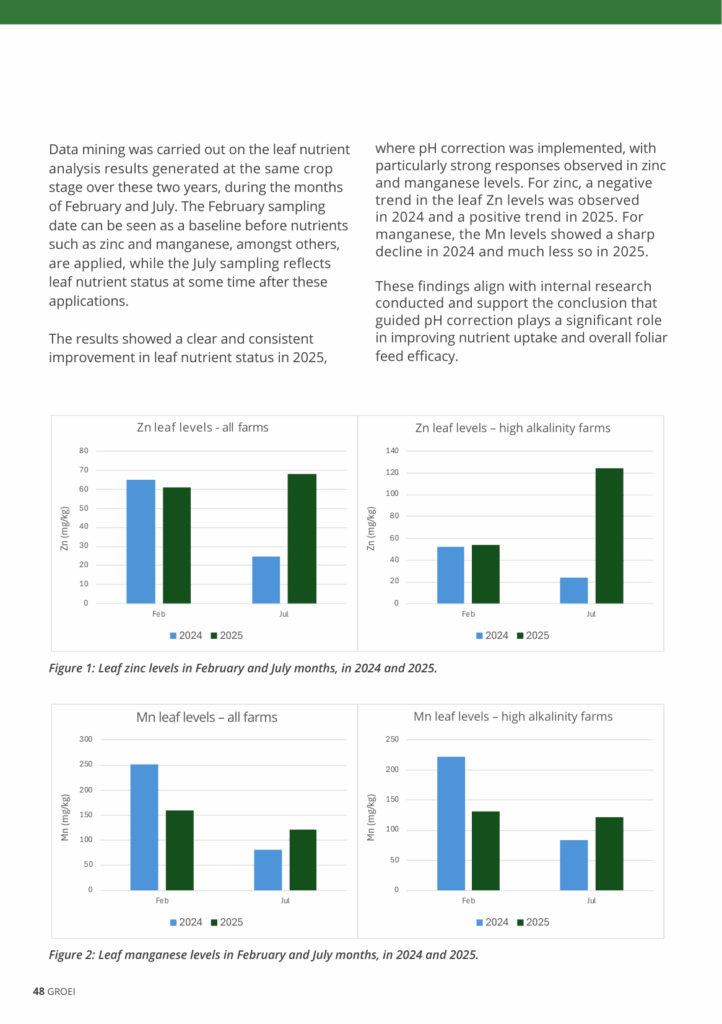
Data analysis over two consecutive years was carried out at a specific citrus farming entity across all their farms. Water sources used for foliar applications on these farms were analysed to have moderate to high alkalinity, while one particular farm had extremely high alkalinity water.
In 2024, foliar feed applications on the farms in this data set were carried out without pH correction, while in 2025, the same programme was maintained, but each spray was adjusted using STAY@5 according to our data-driven recommendations.
Data mining was carried out on the leaf nutrient analysis results generated at the same crop stage over these two years, during the months of February and July. The February sampling date can be seen as a baseline before nutrients such as zinc and manganese, amongst others, are applied, while the July sampling reflects leaf nutrient status at some time after these applications. The results showed a clear and consistent improvement in leaf nutrient status in 2025, where pH correction was implemented, with particularly strong responses observed in zinc and manganese levels. For zinc, a negative trend in the leaf Zn levels was observed in 2024 and a positive trend in 2025. For manganese, the Mn levels showed a sharp decline in 2024 and much less so in 2025.
These findings align with internal research conducted and support the conclusion that guided pH correction plays a significant role in improving nutrient uptake and overall foliar feed efficacy.
Figure 1: Leaf zinc levels in February and July months, in 2024 and 2025.
Figure 2: Leaf manganese levels in February and July months, in 2024 and 2025.
Managing variability in water quality
Water quality remains a critical variable in spray applications, particularly in regions with high alkalinity. In many cases, foliar sprays are applied without any form of pH correction, limiting their potential effectiveness.
It is also important to recognise that water quality can change over time, due to rainfall patterns and other factors, which influence pH and buffering requirements.
Regular water analysis should therefore be carried out ideally at least twice per season where water quality fluctuation is expected throughout the spray programme, in order to maintain accurate and effective spray programmes.
Conclusion
STAY@5 continues to deliver reliable pH correction as part of a proven adjuvant offering, but its value now extends beyond buffering alone. Through the integration of water analysis, product interaction data and targeted recommendations, it enables a more precise and informed approach to foliar nutrition and biostimulant applications.
By ensuring that each spray mixture is optimised for nutrient uptake, producers can maximise the return on their foliar inputs and achieve more consistent results in the field. In an environment where margins are tight and performance matters, precision pH management becomes a key driver of profitability.
For more information, please contact Agri Technovation or your local LAC agent.